
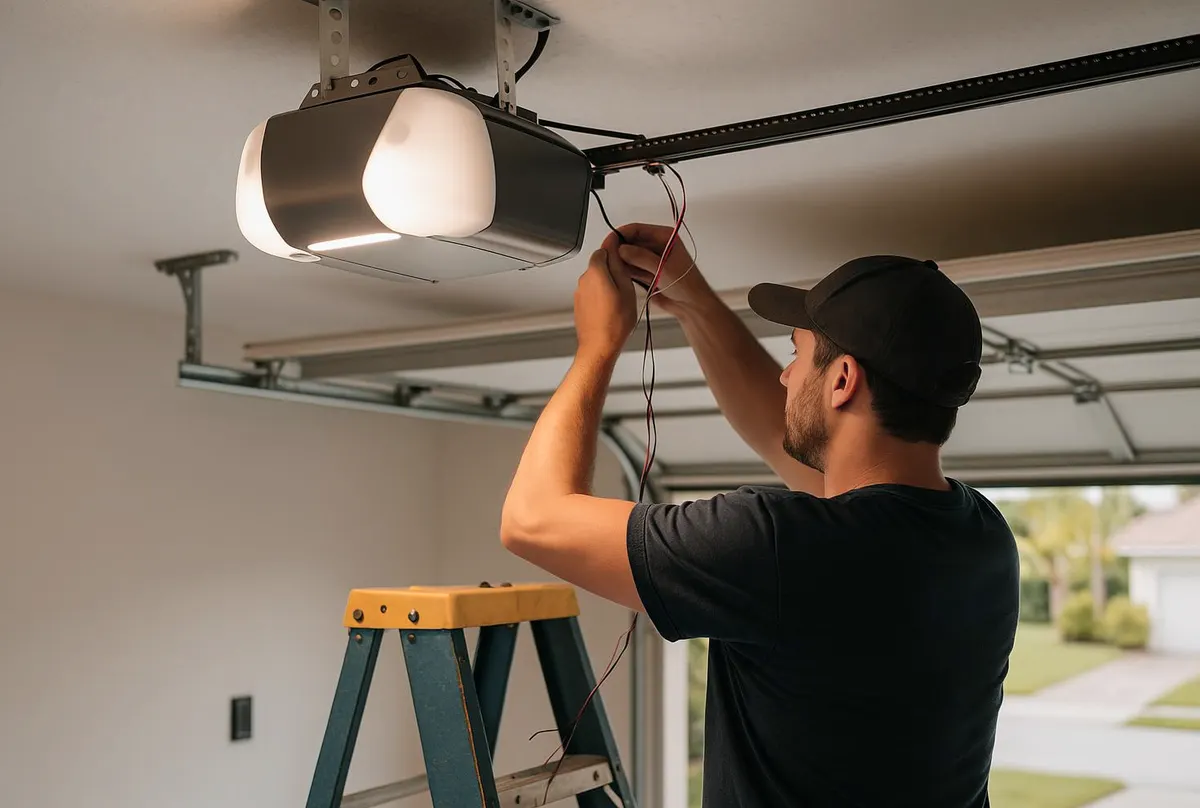
What a Technician Sees on a Typical Track Call
The call usually starts the same way: "My door is making a grinding noise and it looks crooked." On arrival, the door is often stuck halfway, leaning to one side, or visibly gapped away from the track on one of the bottom corners. Sometimes a roller has already popped loose and is hanging outside the channel. In a lot of these calls around North Phoenix and the East Valley, the homeowner assumes the opener is failing, but the opener is just doing its best to drag a door through a track that's no longer straight.
Symptoms That Point to a Track Problem
- Binding or hesitation at a specific point in the door's travel, every single time
- Grinding, scraping, or popping noises as rollers fight their way through a narrowed or warped section
- Visible gap between a roller and the track rail, usually near the curve or a bracket
- One side of the door riding higher than the other when closing, or a daylight gap at one bottom corner
- Rollers jumping out of the track, especially on the vertical sections near the bottom brackets
- The opener straining or reversing partway through a cycle even though the safety sensors are clean and aligned
Any one of these on its own could be something else. Two or three together almost always mean the track itself has shifted, bent, or come loose from its mounting.
Causes We Check, in Order
1. Loose or Pulled Mounting Brackets
This is the first thing a technician checks, because it's the most common and the easiest to confirm. Track brackets are lag-bolted into the framing around the opening, and daily swings from triple-digit afternoon heat down to cool desert nights put repeated stress on those fasteners. Over months and years, that expansion and contraction works screws loose. A loose bracket lets the track flex sideways under the door's weight, which throws off the whole alignment even if the rail itself isn't damaged. The fix is straightforward: re-anchor into solid framing, and if the original holes have stripped out, move to a slightly different mounting point or add a backing plate so the bracket actually holds this time.
2. Impact Damage
Next, the technician looks for a dent, kink, or flat spot that lines up with something that could have hit it — a bumper, a ladder, a bike, a basketball backboard pole. A single sharp impact bends the rail inward or outward right at that point, and every roller that passes through it catches or binds. Minor dents in an otherwise straight track can sometimes be worked back into shape on site with track pliers and a mallet. Anything with a sharp crease, a twist, or damage near a bracket seam usually can't be trusted to hold and gets replaced as a section rather than bent back.
3. Track Plumb and Overall Alignment
With brackets secure and no obvious impact damage, the technician checks the track with a level along its full length, comparing both sides of the door. Houses settle, walls shift slightly over the years, and a track that was plumb at installation can drift out of true. This shows up as a door that closes unevenly even though each individual rail looks fine on its own. The fix is a full realignment: loosening the bracket bolts, shimming as needed, leveling the rail, and checking the gap between roller and track at the top, middle, and bottom before retightening everything.
4. Worn or Degraded Rollers
Plastic and nylon rollers take a beating from UV exposure and surface heat radiating off the door and framing, and they don't fail quietly — they get brittle, crack, or develop flat spots. A roller that's no longer round rides unevenly in the channel, which puts side-loading stress on the track with every open and close cycle. Left alone, this is actually one of the slower causes of bent track, because the roller is quietly hammering the rail out of shape over time instead of all at once. The fix is replacing the rollers, typically with sealed steel ball-bearing rollers that hold up better to sustained heat than standard plastic.
5. Cable or Spring Imbalance
If the tracks and rollers check out but the door still pulls to one side as it travels, the next check is the lifting cables and torsion springs. A cable slightly off its drum, or springs that have fatigued unevenly, will pull one side of the door up faster than the other. That constant sideways tug stresses the track over time even when the track was installed correctly. Rebalancing involves resetting cable tension and, if the springs are mismatched or worn, replacing them as a matched pair so the door lifts level.
6. Curve Radius at the Horizontal Transition
Last, the technician checks the curved section where the vertical track transitions to horizontal. If this radius was installed slightly too tight or too wide for the door and track type, the door will bind at that exact spot on every cycle — the same complaint as a bent track, but caused by a build error rather than damage. Correcting it means swapping that curved section for one matched to the door's specs.
Monsoon Dust Worth Mentioning
During monsoon season, grit and dust pack into the track channel and can mimic a bent track by making the door bind in the same spot every time. A technician checks for this early since clearing and lubricating the channel is a much simpler fix than anything structural — but forcing a gritty door open and closed repeatedly can bend a track that started out fine.
When to Call Phoenix Garage Door Pro
If your door is binding, grinding, or closing unevenly, it's worth having it looked at before a roller jumps the track entirely and the door comes down on an angle. Our Cable & Track Repair service covers everything from bracket re-anchoring and track realignment to full section replacement, and if the imbalance traces back to the springs or cables, we handle that in the same visit. For doors that are holding up but showing early wear from the heat, our Preventive Maintenance service catches loose brackets and tired rollers before they turn into a misaligned track.
If your garage door in Phoenix, Scottsdale, Tempe, Mesa, Glendale, Chandler, Cave Creek, or Paradise Valley is sticking, scraping, or sitting crooked, call Phoenix Garage Door Pro and we'll get it running straight again.